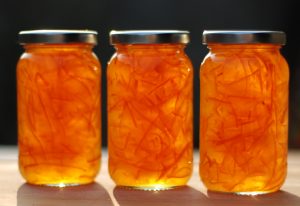
 Recent press reports about the way marmalade will be labelled in future created a number of conflicting reports about what the changes will mean for UK marmalade producers. Far from changing our understanding of a heritage preserve, the new rules will mean that marmalade is, as it always has been, a citrus product and will be labelled with the name of the citrus e.g. Seville orange marmalade. This will help especially exporters to EU countries where the use of the word “marmalade” is often attributed to a fruit spread. Coincidentally, my MP Tessa Munt had secured a debate “ regulation of the marmalade market” in the House of Commons, a couple of weeks after the press reports.
Last year I went to see Tessa with my concerns about the use of the word marmalade on jars made from a combination of citrus and non citrus ( e.g. Orange and Rhubarb) or citrus and vegetable ( e.g Lemon and Horseradish). Also, marmalades labelled with a total sugar content below the regulated 60% chiefly 50-59%. The Jam and Similar Products Regulations, 2003 make it clear that marmalade is made from citrus and the total sugar content in the jar should be 60%. Reduced sugar marmalades are 25-49%. There is no listing for 50-59%, a loophole exploited by some manufacturers.
Under the Windsor Agreement, Northern Ireland will amend their Jam and Similar Products Regulations in June 2026. The Breakfast Foods ( Amendment ) Regulations ( Northern Ireland) 2026, section 4 amends the Jam and Similar Products (Northern Ireland) Regulations 2018. Total sugar content of sweet preserves will no longer be listed on a label. Instead, nutritional information will list the percentage of sugar within the value of carbohydrate.
The proposed changes to labelling ( once adopted by England, Wales and Scotland) will also allow the UK to align with EU countries to label any fruit spread as marmalade e.g Strawberry Marmalade and the 60% sugar content might not be universal. In recent years, the annual Marmalade Awards in Penrith has awarded Golds to many entries not made entirely from citrus or with a total sugar content of 60%. In 2025, Double Golds ( a top award) were awarded to a Yuzu and Pear ( citrus and non citrus) and an Amalfi Lemon Marmalade with 54g total sugar content. Aren’t we gradually losing a heritage product?
Last December, Tessa asked me to write a briefing paper and subsequent responses to questions from her office. There was a last minute scramble to assimilate the implications of the new labelling rules. At the end of Tessa’s speech, on 15th April she had five requests for the Minister of State, DEFRA, Dame Angela Eagle. These referred to sugar percentages to determine the type of marmalade, the use of refractometers to measure the percentage of sugar in the jar, enforcement of the permitted additional ingredients in marmalade, mandatory labelling of nutritional information, and new legislation permits that only citrus fruits can precede the word “marmalade” on labels.
Dame Angela Eagle’s responses touched on the 60% total sugar content and enforcement of the permitted ingredients as listed in current regulations. Follow up questions in writing from Tessa Munt will be sent to the Minister. It was a privilege to attend the debate and if you wish to read more, the full text is in the Hansard link below.
Minister’s Responses Marmalade June 2026
Following the debate, in April 2026, responses were sent from the Minister to my MP. Mostly, they referenced the responsibility of Trading Standards to enforce our food regulations regarding marmalade. In particular, two of the replies have raised further questions.
Question one. Sugar content percentages.
The Minister referenced a set of standards called the Codex Alimentarius Standard CXS 296-2009 as the reason why our suggestion of classifying 25-49% as reduced sugar, 50-59% as a preserve and 60% plus as citrus marmalade.
According to Codex Alimentarius Standard CXS 296-2009, “preserves” and “conserves” are addressed in the standard. “ Specifically, Section 1.2 requires these terms to meet the same regulatory criteria for minimum fruit content and sugar levels as standard jam or extra jam.” Therefore, it seems that jam, conserve and preserve can all be applied to a jar of a mixture of fruit and sugar.
My understanding of a preserve is a thick spread or condiment made of whole or chopped pieces of fruit or vegetables cooked with sugar or sugar and vinegar until tender and stored in airtight jars for example jam, marmalade, jelly, chutney, pickles, fruit cheeses and butters.
A conserve is made by slowly cooking a mixture of fruit with sugar. Unlike traditional jams, which are typically made from a single fruit, conserves often include added ingredients like dried fruits, nuts, or spices, resulting in a chunky texture.
Since 2013 and the Parliamentary Jam debate, https://www.theyworkforyou.com/whall/?id=2013-10-30a.285.0 some manufacturers have started labelling reduced sugar jams and those in the 50-59% range as preserves, hence our suggestion that marmalade products within this range be labelled as preserves.
The standard also describes a product I have not heard of, a non citrus marmalade, prepared by cooking fruit, whole, in pieces, or crushed adding foodstuffs with sweetening properties to obtain a semi-liquid or thick liquid.
Overall, the reference to the Codex sent me down a rabbit hole that provided no answers to our question about sugar percentages in marmalade and our suggestions regarding reserve descriptions.
The Minister’s answer to question 1 does not take account of Defra’s Guidance on Food manufacturing, processing and standards ; preparing your business, dated 1/6/26.
“For reduced sugar jams, jellies and marmalades: the ‘reduced sugar’ provision in domestic rules (requiring a soluble dry matter content of not less than 25% and not more than 50%) will be removed, and reduced sugar, jellies and marmalades will need to meet the reduced sugar definition of a minimum of 30% less sugar than a full sugar product as set out in Regulation 1924/2006 “
Currently, a marmalade with 60% total sugar content and above is regarded as a “full sugar product”. A reduced sugar product will have a minimum of 42% total sugar content ( 30% of 60%). What is the maximum for a reduced sugar product? We need the range clarified and if the maximum is below 59% then we need a reserved description for the unclassified percentages.
Question 3 Enforcement of permitted additional marmalade ingredients
The Minister said “ My officials will raise this with enforcement authorities.
If you have any insights of particular cases that are not complying with the rules then do pass this information either to your local authority or the home authority of the company concerned. Local Authorities are required to enforce the law and will act on any information. It may be that a company is not aware of or has forgotten about the list of permitted ingredients and simply needs to be signposted or reminded by their local enforcement officer.”
Overall, the Minister is relying on Trading Standards Officers to enforce the regulations. I will continue to follow the changes in labelling and I have sent these comments to my MP.