When making marmalade, if you want to make an excellent product it helps to have good quality equipment. I classify equipment into essential items and time saving items. Many of the latter are recent acquisitions that have saved me hours of chopping and cooking and reduced my energy bills. If you are a keen cook, you may already have some of the essential items in your kitchen.
Essential items
Kitchen scales
A set of flat kitchen scales measuring 5g to 5kg are needed for weighing citrus and sugar. They are also necessary when calculating the cooked weight of fruit before adding sugar to create marmalade. A wooden or silicon trivet is needed also to protect the scales when hot pans are put on top to check the weight of the contents.
Measuring Jugs
These are used not only for measuring water in recipes but also as an aide to potting up marmalade.
Chopping boards and knives
I have a favourite wooden chopping board for slicing peel and I prefer small serrated knives when shredding peel. Whatever your preference, make sure the board is big enough to prepare the weight of fruit and your knives are sharp.
Stainless steel lidded pan
Often called stockpots, a 6-9 litre stainless steel pan is by far the best pan to use when making marmalade. The lid is used during the first stage of cooking the fruit, helping it to simmer very gently, thereby softening the peel and extracting pectin. Pans vary in price, but I recommend investing in a top quality pan. I have two pans that have made marmalade for 30 years and I expect they will outlive me. One is a Fissler, the other a Stellar. If your budget is restricted, check out branches of TK Maxx or search apps like Vinted or eBay, Look for a pan with an equal base to diameter measurement, usually around 26cm.
Cotton Muslin
The chopped inner membranes and the pips of citrus fruit are tied up in bags made from thin cotton muslin. Using a thicker grade of muslin will interfere with the extraction of liquid pectin that is created during the first stage of cooking. Muslin squares are sold by specialist cook-shops, but often they are the wrong size for making marmalade. I suggest you either buy a roll of muslin online or if you have a fabric shop nearby, buy it by the meter, then cut it up into squares of 36cm.
Spoons
A large metal spoon for stirring in sugar and testing for a set.
A slotted spoon for removing scum once setting point has been reached.
Small teaspoons for dispersing air bubbles on the surface of the jars.
Jars and lids
The manufacture and retail of jars has come a long way since my early days of marmalade making in the 1990s. Jars and lids are widely available to buy from online retailers. Do shop around as prices vary. I buy jars from Bottle Company South and lids from Wares of Knutsford.
I recommend plain glass jars with new twist top lids for marmalade. I tend to use and reuse jars. I don’t reuse lids as I am not convinced they seal jars second time around.
Timer
A kitchen timer, or a timer on your phone, is essential for setting the cooking time of the fruit and the all important time for boiling the marmalade to setting point, followed by the short resting time before potting up the marmalade.
Time saving items
Citrus press
Glass or plastic squeezers will extract the juice from citrus fruit for marmalade. However, if like me you make a lot of marmalade you might want to buy an electric citrus press. I have one which is as old as my preserving pans. At current prices, a new one will be around £25 and I have seen plenty second hand on retail apps.
Mini chopper
The inner membranes of citrus fruits are chopped up before being tied up in a muslin bag. An electric mini chopper, or the bowl and blade of a food processor will blitz the membranes in seconds.
Pressure cooker
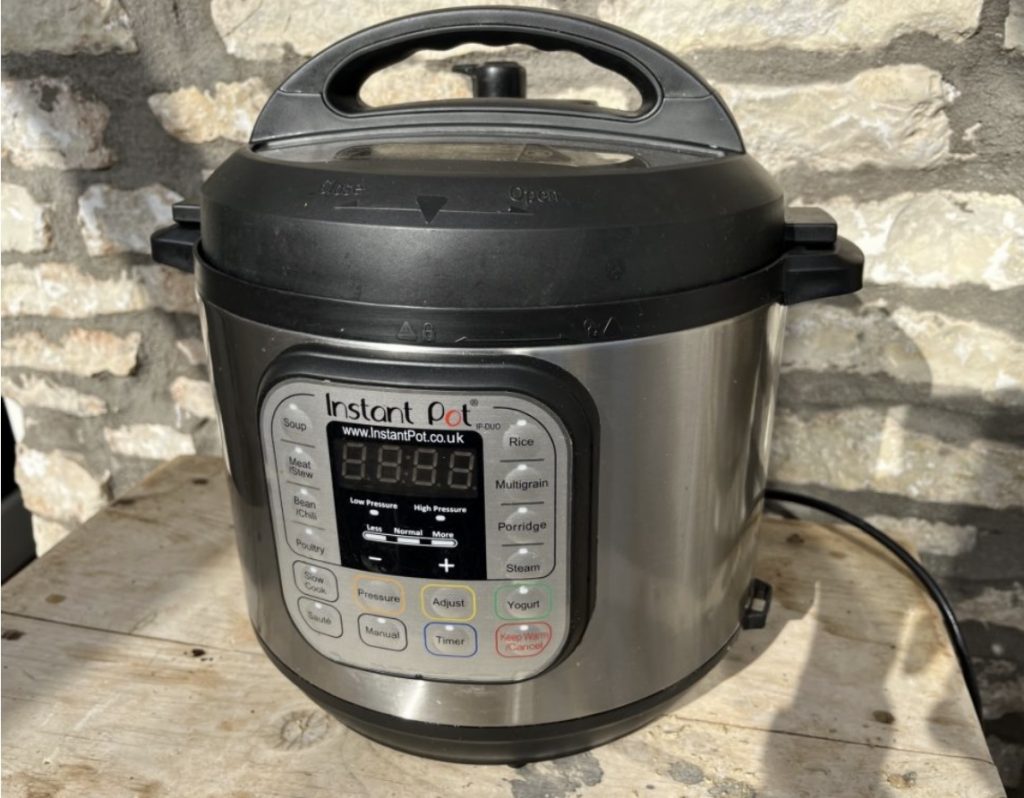 A pressure cooker is a real time saver when making marmalade and it can be used to cook many other ingredients other than citrus fruit.
I have a Tower pressure cooker I use on a gas hob and an electric multi cooker which is very easy to use and control. Both of these have become my go to pieces of equipment when making marmalade.
Pressure cookers save time and energy ( yours and fuel). Ingredients are enclosed in a cooking pot, sealed with a gasket under a tight fitting lid. As the pot heats up, steam is trapped inside and raises the temperature above boiling point to around 122C. The cooking time is shorter than conventional cooking. Modern pressure cookers, used correctly are safe and my electric one allows me to switch it on and walk away from it while it responds to a timed “steaming” function with high pressure for twenty minutes. Once the cooking cycle is complete, the cooker switches automatically to a “keep warm” setting for up to eight hours. This means I don’t have to be around it to wait for the cooking to finish. With my Tower pressure cooker, I turn the gas up to its highest setting, wait for the indicator on the top of the lid to come up, then I turn the heat down to the lowest setting and set my kitchen timer for 20 minutes.
Marmalades can be time consuming if made exclusively in a preserving pan. Once the fruit has been prepared and left for an overnight soak, the initial cooking stage can take around two hours, to soften the fruit and extract the pectin.
My pressure cookers take around twenty minutes to come up to pressure, twenty minutes to cook and twenty minutes to cool down before opening the pan safely, saving an hour. The cooked mixture is then transferred to a preserving pan, the contents of the muslin bag squeezed for the liquid pectin to go back into the pan, the sugar is added and the mixture is boiled to a set.
Pressure cookers are the unsung heroes of marmalade making. Whenever I give a talk about marmalade, I always ask the audience if any of them use a pressure cooker to make marmalade or any other preserve. I have yet to find anyone who does, and perhaps this description of how useful they are will inspire some acquisitions.