 The majority of problems with marmalade making tend to start with the recipe. An unbalanced list of ingredients, using a combination of citrus and non citrus fruit, a lack of attention to detail, insufficient water to cook the fruit, too short cooking times before the sugar is added, over long boiling times to setting point, too long a time between setting point and potting up, misleading guidance about how to fill and seal a jar. If you follow the recipes in this manual, I am confident you will often make problem free marmalade.
Ingredients
Fruit
If the proportions of acid and pectin rich fruit, water and sugar in your pan are not balanced, the marmalade will be unlikely to set. Nine times out of ten, marmalade fails to set if the recipe does not have a precise weight of ingredients. Listing a number, e.g 4 grapefruit will mean a variable weight. Oranges and lemons too vary in weight. It’s worth noting that marmalade is made from citrus fruit and not a combination of citrus and other fruit. Apart from contravening the regulated definition of the product marmalade, combining citrus and other fruit, sets the preserver up for making a preserve that is very different from marmalade.
Water
The volume of water listed in the recipe should be sufficient to soften the peel. As a guide, for every 675g citrus, I add 1.75 litres water. Insufficient water and too short a cooking time will fail to soften the peel and extract the pectin necessary for a good set.
Preparation
Recipes that suggest removing and discarding the pith of the citrus will reduce the overall amount of pectin released into the pan during the first stage of cooking.Selecting too thicker grade of muslin to hold the chopped membranes and pips will also reduce the amount of pectin released into the pan.
Getting a set
If the contents of the preserving pan are not reduced sufficiently, too much cooking liquid will be left in the pan and that will delay setting point. With excess liquid, a long boil will follow after the sugar is added and a set might be elusive. The volume in the pan should be reduced to a weight that will give you proportions of fruit, pectin and acid in harmony, ready to add the sugar. The best way to reach this point is to follow the weight test guidance explained in the How to make Marmalade chapter.
If you suspect the pectin content of the cooked mixture is not sufficient ( although this is unusual as many citrus fruits are rich in pectin) then a pectin test may help. Remove one teaspoon of the cooked liquid from the pan. Pour the liquid into a small cup or ramekin. Add one tablespoon of methylated spirit and swirl the contents together. A jelly like lump will form when plenty of pectin is present. If the pectin content is medium, the lump will look more like an amoeba. If there is too little pectin, the clot will be broken down into small blobs. Reducing the volume further in the pan should improve the pectin
Sugar
There is only one type of sugar I recommend for making marmalade, granulated cane sugar. It gives a bright colour and an excellent set. I have tried using caster sugar and granulated beet sugar but the marmalade tends to have a cloudy appearance.
Reducing the sugar in the recipe means a slacker, not set consistency and the marmalade could have a shorter shelf life. The trend normalising “soft set” as acceptable is a misleading way of saying the marmalade is set. The correct consistency is gelled, similar to a jelly preserve. If the consistency is runny or rigid, it’s not marmalade.
Avoid using Preserving sugar or Jam sugar. Preserving sugar is more expensive than granulated cane sugar and when I use it there always seems to be a lot of scum to clear after setting point. Jam sugar has added pectin which should not be required for marmalades.
Setting issues 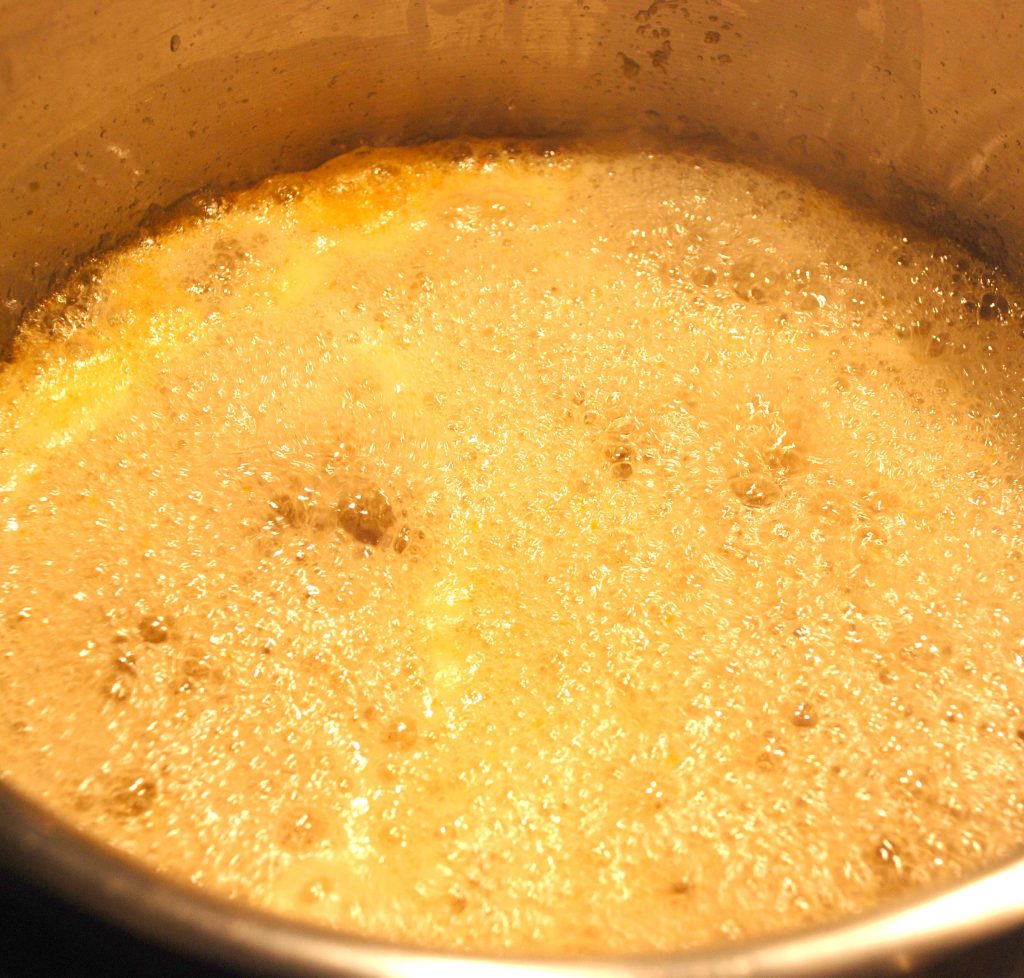
I usually make small batches of marmalade, with 675-700g of fruit. Once the sugar is dissolved, a boil to a set takes an average of 8 minutes. Prolonged boiling times, up to 30minutes, a frequent recommendation in some digital recipes often results in syrupy, caramelised marmalade, a burnt pan and evidence of an unreliable recipe.
A full rolling boil looks like a foaming fizzy drink. Without a full boil, marmalade will struggle to set, so it is important to use a large enough pan, so that there is little risk of the marmalade boiling over.An ideal pan has a height that is less than the base circumference, for example, 18cm high, 26cm circumference.
The set
A well set marmalade should set in the jars and be ready to eat within hours. The process starts as soon as setting point is reached. There are three ways to test for a set; using a plate, a thermometer or a spoon.
I would like to see the plate test confined to history, as it is a most distracting test. Assuming I remember to put a plate to go cold in the fridge, I leave a spoonful of the marmalade on the plate while I wait for it to wrinkle when I push it with my finger. Meanwhile, what do I do with the boiling mass of marmalade? Turning off the heat kills the temperature, leaving it to boil will boil away flavour. I have used a range of thermometers including digital and often the readings under or overset the marmalade.
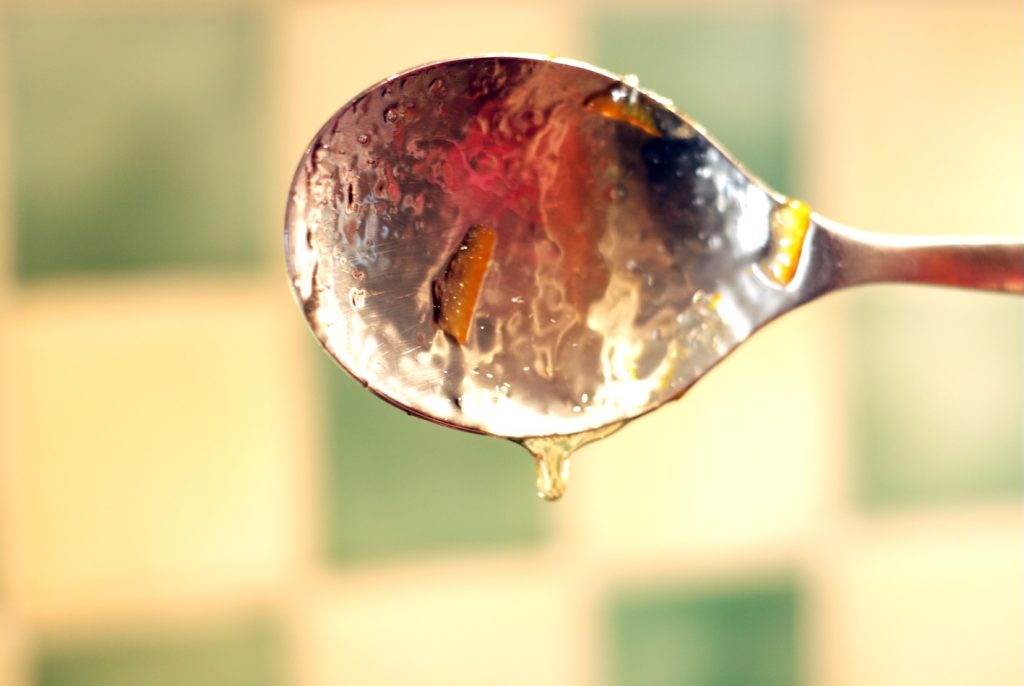 I prefer the flake test. Dip a large spoon into the pan and scoop out a spoonful. Lift the spoon above the pan and turn it horizontally. If the marmalade has reached setting point of 104.5C (220F) it will drip then hang or sheet on the side of the spoon, looking rather like a small fragment of stained glass.
Just before potting up the marmalade, if you carefully drag your spoon across the surface of the marmalade, you should see a wrinkle, another sign of setting. Also, if you depress the back of the spoon gently on the surface of the marmalade, it should feel slightly dense and resistant.
Potting up
Given the amount of time it takes to make marmalade, a surprising number of issues can arise if the jars are not filled and sealed correctly. Glass jars are the best containers for marmalade. Also, jars with new twist top lids are my preferred choice as if used correctly, they will seal the marmalade and ensure the contents are airtight and will keep.
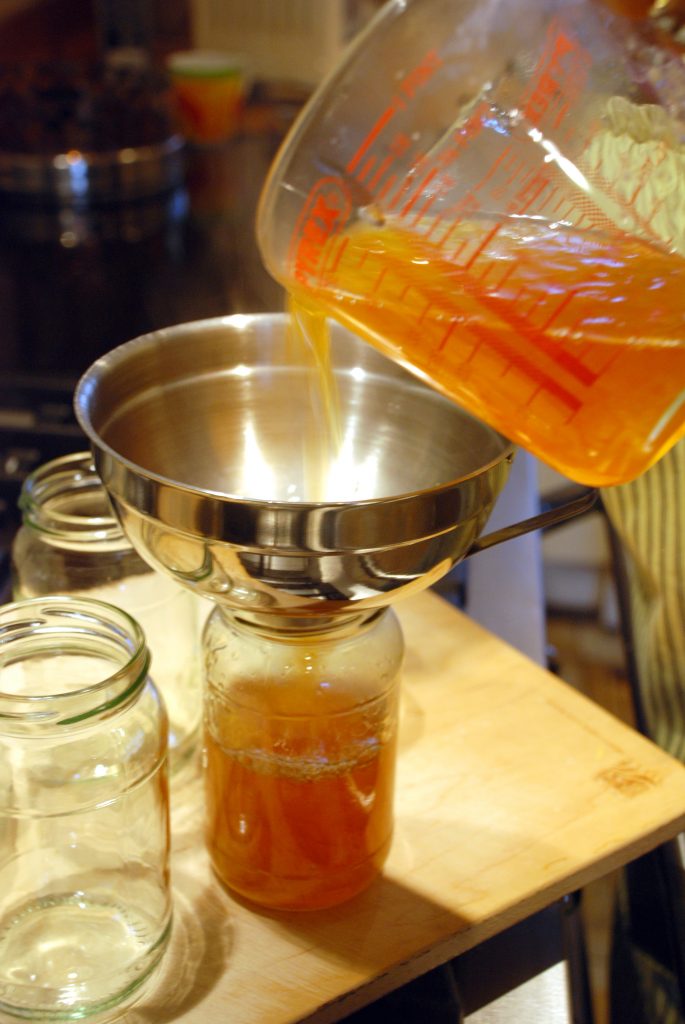 Always fill the jar to the brim and immediately seal the jar with a new lid. As the jar cools and sets, an airtight seal is created between the surface of the marmalade and the underside of the lid. Three quarters full jars will not create the air vacuum necessary to create a seal. The modern practice of inverting the jar to “sterilise” the lid is unnecessary, and will add a smear of marmalade to the underside of the lid. If you use new lids and pot up within 10 minutes of reaching a set, your marmalade will be fine. Also adding a waxed disc and a lid is unnecessary as it creates a moist barrier and might cause spoilage.